
Transylvania County Parole Versus Probation
North Carolina Community Supervision, a part of the North Carolina Department of Adult Correction, supervises people on probation, parole, and post-release supervision. Those labels are not interchangeable. Probation is a court-ordered sentence served in the community and may begin without a prison term. Parole is conditional release tied mainly to older or special sentence structures. Post-release supervision is the period of control that follows prison for covered Structured Sentencing cases. The North Carolina Post-Release Supervision and Parole Commission sets conditions and makes release or revocation decisions within its authority.
A Transylvania County jail release record does not, by itself, show which form of supervision applies. A person may leave the Detention Center on bond with no NCDAC supervision, begin probation under a judgment, transfer to prison, or later leave prison on post-release supervision. Start with the sentence and state offender record. Then confirm the current service status and assigned office. That sequence keeps a physical release from being mistaken for the end of legal control.
| Status | How it starts | Best verification |
|---|---|---|
| Probation | A court orders community supervision, sometimes without prison. | NCDAC offender record, judgment, and Community Supervision office. |
| Parole | The Commission conditionally releases an eligible person under an older or special sentence. | NCDAC history and Commission records for the specific case. |
| Post-release supervision | A covered person leaves prison under Article 84A controls. | Actual prison release event plus active community-supervision status. |
- Discharge
- The documented end of the named term, such as supervision or the full sentence.
- Absconder
- A person whom supervision authorities allege stopped complying or maintaining required contact.
- Revocation
- An official action that withdraws community release or supervision after the required legal process.
- Detainer
- A request or hold from another authority that may affect custody or release.
Verify Transylvania County Post-Release Supervision
The NCDAC Offender Public Information Search is the first state source for a person who may be on supervision. It covers state correctional history, not every county-only booking. Search by offender number when known. A name search is broader, so match the result with conviction county, offense, age or other available details, and sentence dates. Read the current service status together with the chronological incarceration and community-corrections entries. An inactive record is different from an active probationer or parolee record.
Use the following order when the question is whether a released Transylvania County person remains under state control:
- Search OPI and match more than the name. Preserve the label on the NCDAC offender number.
- Open the status and sentence history. Look for an active probation, parole, or post-release supervision episode.
- Note the supervising location shown in the individual record. Do not infer an office from a home address.
- Check the current Community Supervision office directory or ask NCDAC Offender Information to identify the responsible office.
- Use the Commission's official channel when the question concerns a Commission decision or condition. A field office handles reporting logistics but may limit personal details.
No result is not proof that supervision ended. Spelling, an older record, a different jurisdiction, an alias, feed timing, or a restricted record may explain the absence. The broader Transylvania County released inmate search path helps distinguish a county release from state prison release or transfer when custody history is unclear.
Note: An NCDAC offender number is not a county booking number, so keep the source label attached when recording it.
Transylvania County Supervision Office Routing
Office assignment is record-specific. The statewide directory is the controlling route, and the person under supervision should follow instructions from the assigned officer. A courthouse or jail address should not be substituted for a reporting office. Assignments and satellite coverage can change, and the official sources reviewed do not support a promise of walk-in service or a fixed check-in schedule for every Transylvania County supervisee.
An official field roster dated September 11, 2025 places Transylvania in Judicial District 29 with Henderson, Polk, Rutherford, and McDowell counties. It identifies the Hendersonville district office as a routing fallback. This does not prove that each Transylvania County person reports there. Verify the individual assignment in OPI or with NCDAC before travel.
NCDAC Community Supervision, District 291347 Spartanburg Highway, Suite 4
Hendersonville, NC 28792
Phone: 828-393-4402
Fax: 828-697-4571
Verify the current office assignment
The district contact can route a question, but the assigned officer and current individual record control. Calling first is prudent because no Transylvania-specific walk-in policy was published in the official material.
Transylvania County Supervision Status Changes
Conditions are the rules set by the court, Commission, or supervising authority for the specific case. They may govern reporting and other conduct, but a public summary should not guess at conditions that are absent from the record. A field office can confirm reporting logistics for the person involved, subject to privacy and safety limits. The judgment, Commission action, and NCDAC record are stronger than an informal description from a third party.
A violation allegation also does not define the final outcome. Authorities may investigate, seek a warrant, change conditions, or begin revocation proceedings under the law that applies to the case. If OPI suggests absconder status, that generally means supervision authorities allege the person stopped complying or maintaining contact. The person remains under legal supervision. Do not interpret the label as unconditional discharge, and do not approach someone based on a public record. Use official law-enforcement or NCDAC channels for a safety concern.
NC SAVAN through VINELink can provide notice of some prison, parole, probation, post-release, transfer, and discharge events. It is useful corroboration, not a certified order or permanent archive. The state offender history and controlling agency record remain the sound sources for an exact Transylvania County supervision status.
Transylvania County Supervision Discharge Records
Supervision ends through a documented action under the sentence and law that apply to the person. Completion may appear as an inactive NCDAC status, an end date in the service history, a Commission action, or another discharge entry. Read the label closely. Discharge from post-release supervision can mark sentence termination for a covered Article 84A case, while the end of one probation case does not establish that all other cases or holds ended.
North Carolina public-record access is broad but subject to statutory limits. G.S. 132-6 governs inspection and copies of public records, while confidential, sealed, expunged, juvenile, victim, medical, and certain investigative material remains restricted. For a durable state record, use NCDAC's public-record request channel. State the offender number, the exact supervision or discharge field sought, and a narrow date range.
A court case can explain a probation judgment or later modification, but it may not show each field-office event. Likewise, an old county entry/release summary proves the Detention Center ended a custody episode, not that NCDAC supervision later ended. Keep those records separate and describe what each custodian can prove.
Transylvania County Parole Review Records
Parole is now relevant mainly to eligible older and special sentence populations. The Commission's parole process says it does not hold formal hearings or meet personally with offenders during possible-parole review. Eligible cases are reviewed one by one, and a majority vote is required. There is no conventional formal-hearing calendar to consult. A denial may lead to a later review date, with review cadence depending on the offense and governing law.
North Carolina instead publishes monthly Discretionary Parole Reviews from September 2024 forward. Those reports show reviewed cases and public decisions such as incomplete or suspended decisions and specified parole outcomes. They are not an all-record database, and other Commission records can remain confidential. G.S. 15A-1371 is central to parole eligibility, but offense date and sentence type must be checked before applying it.
The official monthly review page shows how Commission results are presented:
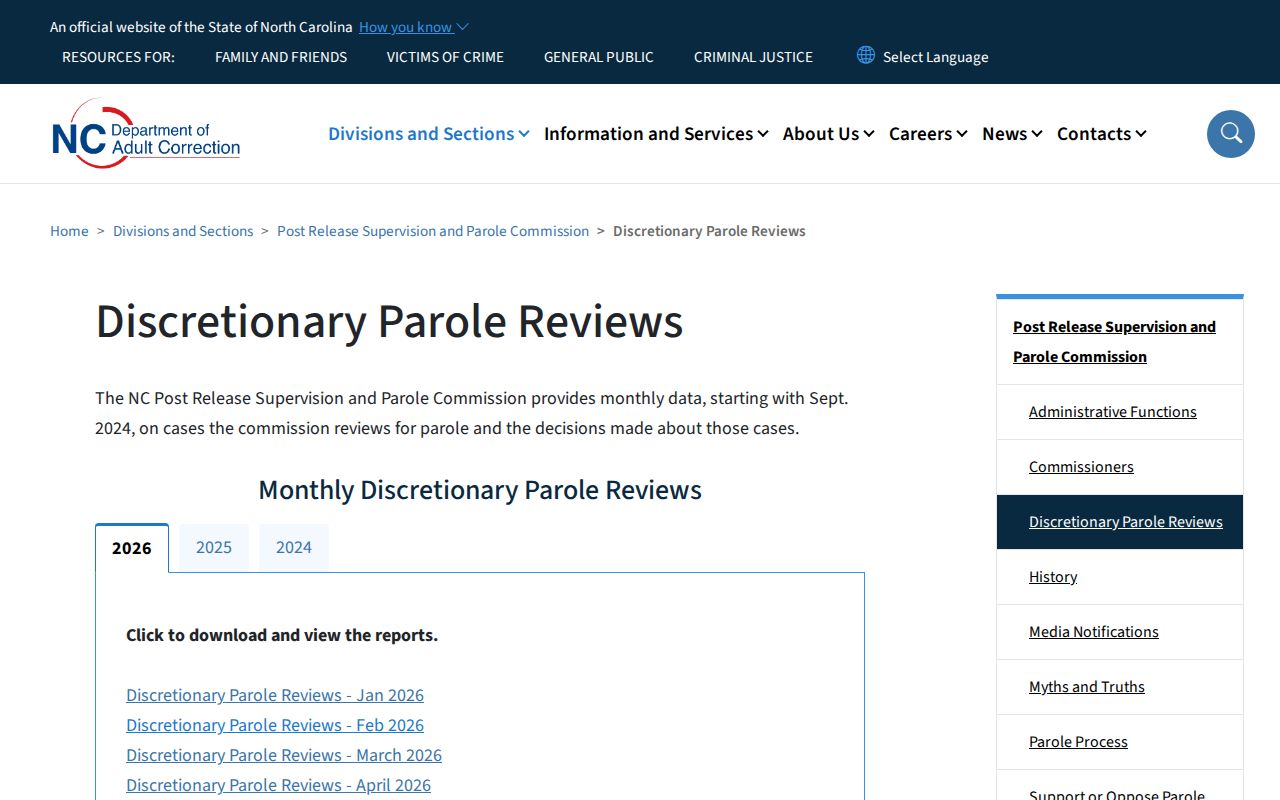
This source is best used to confirm a listed monthly decision, then read it with the person's NCDAC history. Absence from a report does not prove approval, denial, or discharge.
Note: A monthly parole review report is a public results channel, not a formal hearing calendar or full Commission case file.
Which Transylvania County Supervision Office Applies?
Transylvania County's distinctive supervision issue is routing. The current statewide Community Supervision directory and the person's own record control, not the county courthouse or Detention Center address. Even the District 29 roster is a fallback rather than proof of one required reporting site. This matters when a person leaves prison on post-release supervision because physical release has occurred while state supervision continues.
The same rule resolves an absconder entry. That label indicates alleged failure to maintain required contact; it does not move the person outside the sentence or convert the case into discharge. Confirm the active service record, the assigned office, and any official action. If a directory and older roster differ, rely on the current NCDAC route and ask Offender Information to reconcile the office.
County and state records can also describe different stages without conflict. A Transylvania County release summary may show when the sheriff ended local custody, while OPI shows that probation began or state supervision continued. The Commission record may address release or revocation authority, and a community office record may identify where reporting occurs. Match each question to the agency that created the field. For lasting proof, request the narrow record instead of relying only on a phone answer or a status screenshot that may later change.