
Transylvania County Projected Versus Actual Release
A projected release date is a current sentence calculation. It may reflect the judgment as entered, credit for time already held, sentence structure, earned time, and later audits. An actual release date records an event that the corrections system says occurred. Neither term necessarily means unconditional discharge. A state prisoner may leave the prison and enter post-release supervision, remaining under NCDAC control in the community.
County custody works differently. A pretrial person at the Transylvania County Detention Center usually has no NCDAC projected date. A bond order or court event may authorize release, but staff must receive and process it and clear any other cases or holds. A short county sentence may have a calculable end, yet the official sources reviewed did not publish a Transylvania-specific local good-time formula or weekend adjustment. State prison rules must not be copied onto a county booking.
A transfer also matters. If a person leaves the county roster and appears as an active NCDAC inmate, the event is consistent with transfer to state custody, not community release. Label the county departure and state incarceration separately.
Find Transylvania County Projected Release Dates
Begin by deciding whether the person is a county detainee, an NCDAC prisoner, or someone held by another authority. The NCDAC Offender Public Information Search is built for state correctional control and does not contain every person booked locally. The Transylvania jail portal covers county custody and former bookings, but its released grid shows Admit Date rather than a projected or actual release date.
- Check the current custodian. A person shown in the county roster is not proven released by a court event or future date.
- For an NCDAC prisoner, search by offender number when known. Otherwise use the name and match conviction county, offense, demographics, and sentence dates.
- Open the sentence details and record the precise label: Projected Release Date, Actual Release Date, supervision status, or discharge.
- Capture the displayed status and the date of access. Some projected fields are marked
UNAUDITED. - For a county sentence, contact the Detention Center or clerk and compare the commitment, jail credit, release order, and any holds.
- Recheck near the expected event and after it passes. Confirm what occurred through the agency record.
The Transylvania County released inmate search and records path explains how the sheriff summary and court order work together. The court record shows legal authority and sentence terms. The sheriff entry/release summary shows when county staff ended the custody episode and whether a transfer followed.
Note: Preserve each date label; admit, court, projected release, actual release, supervision, and discharge dates answer different questions.
North Carolina Sentence Credit Rules
G.S. 15A-1340.13 governs active terms under North Carolina Structured Sentencing. An active term begins on commitment and receives credit as the law permits. Subsection (d) describes release at the maximum imposed term less earned time awarded by NCDAC. Earned time cannot reduce the sentence below the governing statutory structure. The NCDAC sentence-credit policy further ties credits to law, conduct, program or activity, sentence, and eligibility rules.
There is no sound universal claim that each North Carolina prisoner serves a fixed percentage. Some minimum and maximum formulas may produce ratios that invite a shortcut, but the true calculation depends on offense date, class or level, minimum and maximum terms, credits, special law, consecutive or concurrent sentences, and any post-release period. Older Fair Sentencing or parole-eligible terms, life sentences, impaired-driving sentences, misdemeanors, and other special structures can differ.
Article 84A governs post-release supervision for covered cases. For more specific felony timing, G.S. 15A-1368.2 contains the statutory mechanics, including distinct periods for sentence classes and certain registry offenses. The current statute and individual judgment should be read instead of building a generic calculator. Exact computation belongs with NCDAC and the court record.
Local jail credit has its own boundary. G.S. 148-13 directs NCDAC to adopt earned-time rules and addresses distribution and use of applicable rules by local jail administrators for sentenced prisoners. It does not state the credit awarded in a particular Transylvania County sentence. Behavior, work or program eligibility, sentence type, and the commitment record may matter.
Why Transylvania County Release Dates Move
A projected date is a live result of legal and administrative inputs. It can move in either direction when the source data changes. The safest practice is to save the label and access date, then check the current status and actual event later. A date that has passed while OPI still says Active Inmate is not a basis to announce release.
| Change | Effect on the projected date | Source to check |
|---|---|---|
| Corrected judgment | An amended sentence can replace the term used in the calculation. | Court judgment and NCDAC history |
| Sentence structure | Added, concurrent, or consecutive entries alter the controlling term. | Sentence history and docket |
| Jail-credit audit | Verified prior custody credit may change the computation. | NCDAC audit and commitment record |
| Earned-time change | Award, forfeiture, or restoration can move the expected date. | NCDAC sentence record |
| Discipline or program status | Eligibility or credit consequences can affect the calculation. | NCDAC record and policy |
| Revocation or return | Return from supervision can create a new custody computation. | Commission, court, and NCDAC entries |
| Detainer or other custody | One release may lead to another sovereign rather than the community. | Receiving agency and source custodian |
| Administrative correction | A data or sentence-audit fix can change the displayed field. | NCDAC Offender Information |
A parole decision affects only a sentence governed by the relevant parole law. Modern Structured Sentencing cases often use post-release supervision instead. Do not assume a parole grant or denial is part of every Transylvania County projected date.
A change in one case may still leave another term in force. When the record lists more than one docket or sentence, identify which one controls the displayed date and whether the terms run together or one after another. The public display can vary by sentence era and record. It should not be forced into a single formula. NCDAC Offender Information can clarify a field, while the court clerk supplies the official judgment that created the term.
Confirm Transylvania County Release Dates
After the projected date passes, look for an Actual Release Date and read the current status. An active probationer or parolee status can show that the person is in the community under NCDAC supervision. It does not show unconditional sentence discharge. An inactive record paired with the relevant actual release and sentence history can be strong state confirmation, but each service episode still needs context.
For a county release, request the nonmedical entry/release summary from the Transylvania County Sheriff's Office or Detention Center. Ask for the booking or admission date and time, release date and time, release or transfer type, and destination if public. A court release order explains authority; the sheriff record gives the processed custody event. One case's order may coexist with another hold.
A pending state or county event can also be followed through the Transylvania County VINELink check. NC SAVAN offers custody and release notifications tied to participating county and state feeds. An alert is corroboration rather than certified proof, and the sources do not promise a permanent released-person archive.
Transylvania County NCDAC Release Search
NCDAC maintains a separate Inmate Release Search for state prison releases. It supports searches by county, year, and month or by last name and Soundex. Its county field is the county recorded by NCDAC for the state release. It is not a list of people released from the Transylvania County Detention Center.
The official search page illustrates that state-prison browsing route:
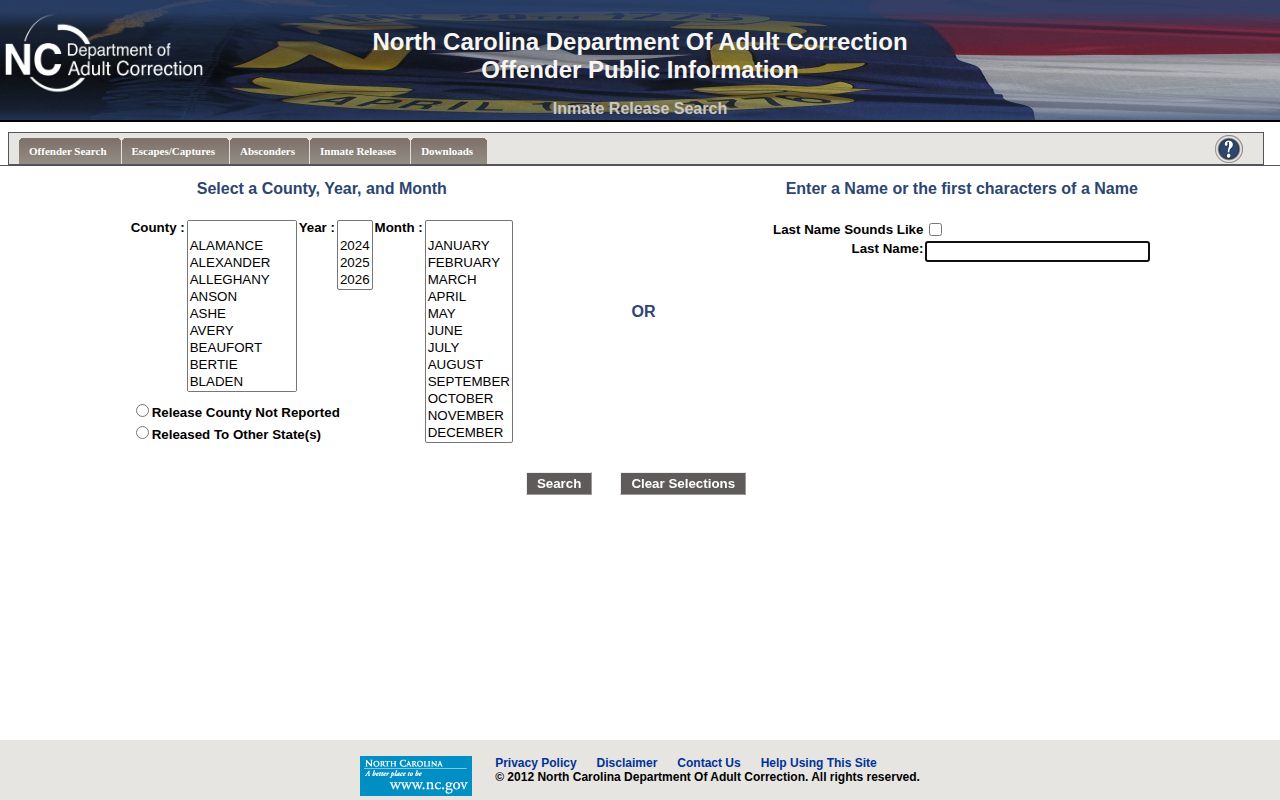
The county and date choices help locate state events, including entries where the release county was not reported or release was to another state. Once a person is found, open the full OPI record and reconcile the actual event with sentence and supervision history.
This search reaches NCDAC releases, not county-only detainees. A person booked and released locally without a state sentence or supervision episode may never appear. Use the Transylvania sheriff record for that event. Conversely, a Transylvania resident can be released from an NCDAC prison elsewhere, so the county jail portal would be the wrong source.
Note: NCDAC release county is a state data field, not proof that the Transylvania County jail processed the release.
Read Transylvania County Release Date Results
Several combinations require care. If the projected date has passed but OPI remains Active Inmate, the computation may have changed, the display may lag, or another sentence or hold may control. Recheck the full record and ask NCDAC Offender Information about the field. If the status changes to Active Probationer/Parolee, physical prison release is likely reflected, but community supervision remains active.
A county released-mode result with an Admit Date does not show the exit date. It locates a former booking. Request the entry/release summary using those booking details. If the county roster disappears and OPI then shows Active Inmate, the records are consistent with transfer into state custody. Describe the person as no longer held by Transylvania County but still incarcerated.
Reaching the minimum term also does not equal unconditional discharge. Structured Sentencing requires service of the applicable minimum, but maximum-term structure, earned time, post-release rules, and any consecutive sentence still matter. Label each conclusion narrowly. When sources conflict, report the conflict or wait for the source agency to correct it.
A court order dated before the sheriff's release timestamp can be accurate. Staff may need to receive the order, verify it, process bond terms, and clear other holds. The physical exit record answers when county custody ended. For a state prisoner, the Actual Release Date answers the NCDAC event, while an active supervision entry explains the next stage. Keeping these dates in separate fields prevents a projected date from replacing the record of what actually occurred.
If the online state record looks wrong, preserve a copy and note the access date. Send the judgment or other correction evidence to the custodian that created the field. The sheriff controls county admit and release data, the clerk controls court orders, and NCDAC controls OPI sentence calculations. One agency generally cannot edit another agency's record.